

🔒 Secure Checkout
·
90-Day Promise
·
Free Shipping $75+

🌱 The Hemp Plant & History
 · Co-Founder & Chief Formulator
Honest Guidance · Daily Routines · Plant Wellness
The Dark Ages of Hemp: Bureaucracy, Science, and the 1970 Controlled Substances Act
· Co-Founder & Chief Formulator
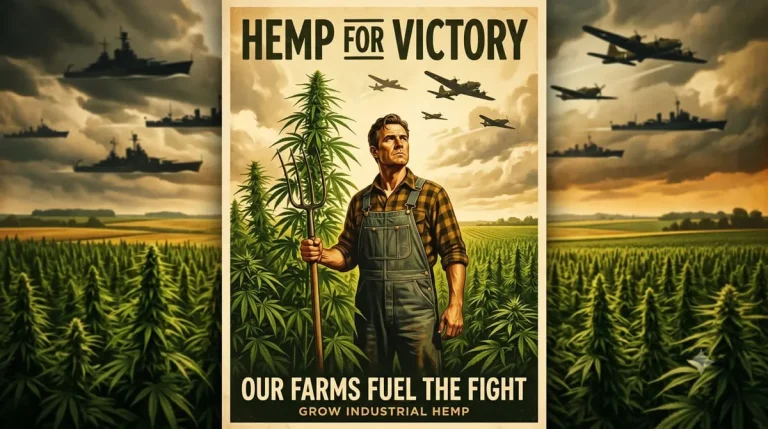
When World War II ended in 1945, the U.S. government quickly retreated from its “Hemp for Victory” campaign. The processing mills were closed, tax exemptions vanished, and federal regulators resumed their quiet, determined effort to regulate industrial hemp out of existence.
The history of American hemp is a saga of immense utility, forgotten promise, and, ultimately, a forced descent into darkness. For nearly 200 years, industrial hemp was a cornerstone of the American economy—essential for rope, canvas, paper, and fuel. Yet, in 1970, with the stroke of a pen, the United States government initiated a 44-year “Dark Age” for this foundational crop.
However, the definitive “chokehold” came not from taxes, but from a dramatic overhaul of drug classification.
The Controlled Substances Act (CSA) of 1970
The Comprehensive Drug Abuse Prevention and Control Act of 1970 (The CSA) was a complete rewriting of American drug policy, signed into law by President Richard Nixon. It established five “schedules” for drugs based on their potential for abuse and medical utility.
- Schedule I: These substances have a high potential for abuse and no currently accepted medical use in treatment in the United States. They are considered unsafe for use even under medical supervision. Examples include heroin, lysergic acid diethylamide (LSD), marijuana (under federal law prior to recent rescheduling efforts/state-level shifts), and ecstasy (MDMA).
- Schedule II: These drugs have a high potential for abuse, but they do have currently accepted medical uses with severe restrictions. Abuse of these substances may lead to severe psychological or physical dependence. Examples include fentanyl, oxycodone (OxyContin), morphine, cocaine, and methamphetamine.
- Schedule III: These substances have a potential for abuse less than those in Schedules I and II. They have a currently accepted medical use, and abuse may lead to moderate or low physical dependence or high psychological dependence. Examples include products containing less than 90 milligrams of codeine per dosage unit (like Tylenol with codeine), ketamine, and anabolic steroids.
- Schedule IV: These drugs have a low potential for abuse relative to those in Schedule III. They have currently accepted medical uses, and abuse may lead to limited physical or psychological dependence relative to Schedule III. Examples include alprazolam (Xanax), diazepam (Valium), and tramadol.
- Schedule V: These substances have the lowest potential for abuse relative to the other schedules. They consist primarily of preparations containing limited quantities of certain narcotics and have currently accepted medical uses. Examples include cough preparations containing very small amounts of codeine (e.g., Robitussin AC).
The Act was presented to the public as a necessary reform for public health and safety. The legislative language was carefully crafted, focusing on “treatment,” “rehabilitation,” and “strengthening enforcement.”
However, buried within the mechanics of the law was a total failure to distinguish between the psychoactive strains of Cannabis sativa L. and the ancient, non-psychoactive industrial hemp variety—a plant that had helped build the nation.
A plant with essentially zero psychoactive THC content was suddenly categorized as one of the most dangerous drugs in the world.
“The distinction between hemp and marijuana is not a new one. In 1776, it was understood. In 1942, it was vital. In 1970, it was bureaucratically convenient to ignore.”
The Consequences of Prohibition
When the government categorizes an essential agricultural commodity as a Schedule I substance, the ramifications go far beyond legal hurdles. It causes a collapse in research, capital investment, and institutional knowledge.
For the next four decades, American universities were barred from studying the plant’s agronomy, genetics, or potential medicinal benefits. We watched from the sidelines as other nations—who maintained a more rational view of industrial hemp—pioneered innovations in textiles, construction materials, and nutritional science.
The 1970 Act forced American farmers into a corner. We became dependent on imports for a resource we once produced in abundance. This era wasn’t just a “ban”; it was a period of deliberate suppression that prioritized political optics over scientific reality and economic independence.
The Cost of Bureaucratic Ignorance
- Economic Death: America, a nation founded on hemp, was forced to import billions of dollars of hemp fiber, seed, and oil from countries like China and Canada.
- Scientific Blackout: Federal classification meant universities and researchers couldn’t study the industrial, environmental, or wellness benefits of the plant without massive regulatory hurdles.
- Lost Innovation: While other countries developed advanced hemp-based bioplastics and construction materials (like hempcrete), America sat on the sidelines.
The Wellspring Commitment to Heritage
Here at Wellspring, we look at the “Dark Ages” as a testament to hemp’s sheer resilience. It is a plant that can be prohibited, plowed under, and lied about, but it continues to return to serve humanity.
We honor that raw, survivalist spirit with our 1776 Heritage Reserve. This is not a polished, industrialized CBD product. It is an unrefined, full-spectrum extract.
- We left in the dark waxes and chlorophyll.
- We preserved the earthy, bitter terpenes.
- We maximized the content with 1776mg of CBD and 250mg of raw CBDa.
Just like the heritage crops of 1776, this oil isn’t meant to be “pretty” or “tasty”—it is meant to deliver the plant’s raw potency in its most authentic form. —
Jason Liss — Co-Founder & Chief Formulator
As a Co-Founder of Wellspring CBD, Jason has been an advocate and pioneer in the cannabis and hemp industries since 1996. Passionate about helping people achieve better health through unique natural supplements, Jason uses his decades of experience to guide readers toward effective wellness solutions.
Discussion (2)
Leave a comment
Share your thoughts

🌱 New Here? First Order
Take 40% Off Your First Order
Join the Wellspring Journal for honest CBD education — enter your name and email to unlock an exclusive first-order code. Instant, no spam, one-click unsubscribe.
🔒 Instant Code
🌿 Zero Spam
✉️ 1-Click Unsubscribe
🌴 90-Day Promise

Hmm is anyone else experiencing problems with the pictures on this blog loading? I’m trying to figure out if its a problem on my end or if it’s the blog. Any feedback would be greatly appreciated. website
Can’t say we are experiencing the problem. If you continue to have trouble, please send an email to hello@wellspringcbd.com