
🔒 Secure Checkout
·
90-Day Promise
·
Free Shipping $75+
🌱 Botanicals & Herbs
 · Co-Founder & Chief Formulator
Honest Guidance · Daily Routines · Plant Wellness
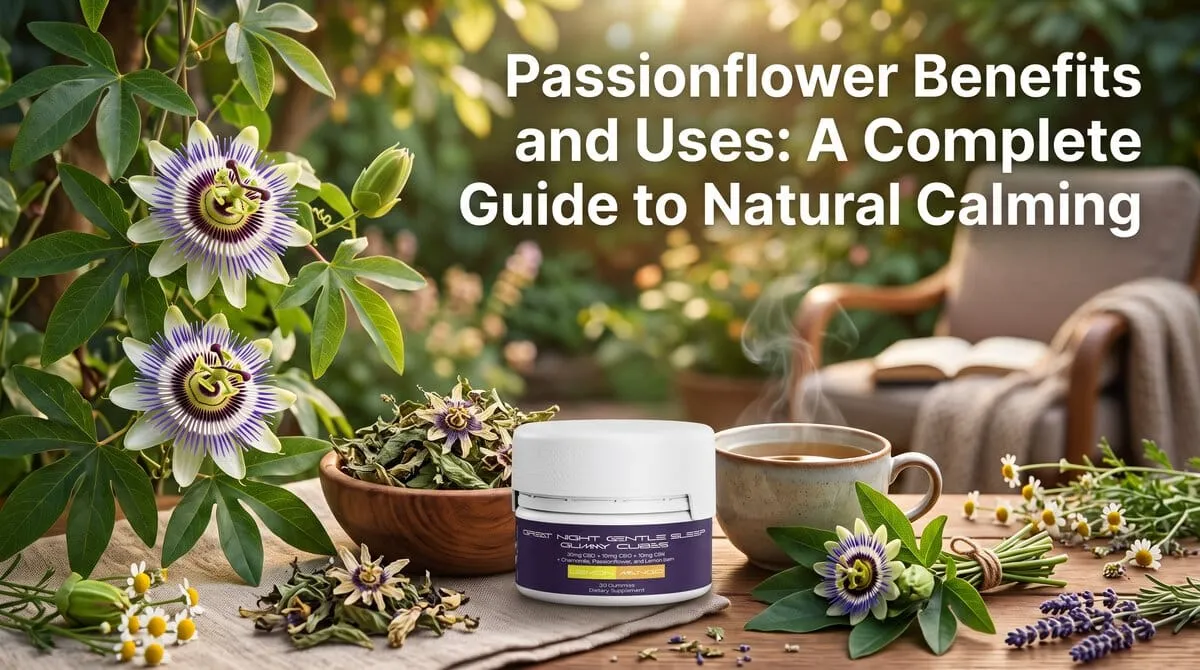
Passionflower Benefits and Uses: A Complete Guide to Natural Calming
· Co-Founder & Chief Formulator
The Passiflora genus carries an air of mystery, its intricate, radial flowers looking more like an alien construct than a garden-variety bloom. Known historically as the “Melancholy Flower,” this botanical marvel offers a grounding, restorative antidote to the modern frenetic pace.
While its appearance is exotic and complex, its impact on the human system is profoundly simple: it helps the mind let go of tension. For those seeking a natural path to calm, Passionflower represents the gold standard in nervine support, balancing scientific evidence with a storied history of traditional use.
The Botanical Identity of Passiflora Incarnata
Passiflora incarnata, often called the “maypop,” is a climbing perennial vine native to the southeastern United States. While many are familiar with the ornamental passion flower or the tropical passion fruit (Passiflora edulis), it is specifically the incarnata species that holds the therapeutic keys. The plant is characterized by its three-lobed leaves and iconic, fringed flowers, which develop into small, edible yellow-green fruits. Distinguishing the medicinal species is critical, as botanical integrity ensures the correct profile of phytochemicals necessary for therapeutic effect.
Historical Roots: From Native American Traditions to Spanish Explorers
Native American tribes, including the Cherokee and Houma, long utilized the plant for its sedative properties and as a poultice for wounds. When Spanish explorers encountered the vine in the 16th century, they were struck by the flower’s unique anatomy, which they interpreted through a religious lens, associating the bloom’s parts with the symbols of the Passion of Christ. This historical reverence paved the way for its integration into European pharmacopeias, where it eventually became a staple for treating “hysteria,” restlessness, and erratic sleep patterns.
The Symbolism and Unique Anatomy of the Passion Flower
The anatomy of the passion flower is truly singular. The five petals and sepals are said to represent the ten faithful apostles, while the corona—the delicate, hair-like fringe—symbolizes the crown of thorns. Beyond the symbolism, this complexity reflects the plant’s internal chemistry. Its biological “design” is optimized for survival, producing potent secondary metabolites that deter herbivores—compounds that, when extracted properly, interact with the human nervous system to soothe and settle.
The Science of Calm: How Passionflower Works in the Brain
Passionflower does not “force” the brain into a sedated state like a heavy tranquilizer. Instead, it acts as an intelligent modulator of the central nervous system. Its primary value lies in its ability to assist the body in returning to a state of equilibrium, effectively lowering the threshold for stress response.
The Role of GABA (Gamma-Aminobutyric Acid) in Nervous System Regulation
At the center of Passionflower’s efficacy is its interaction with Gamma-Aminobutyric Acid (GABA). GABA is the body’s primary inhibitory neurotransmitter, responsible for quieting excitatory nerve activity. When the nervous system is stuck in an “on” position, anxiety and insomnia follow. Passionflower contains constituents that appear to increase the availability of GABA in the synaptic cleft, effectively hitting the “brakes” on overactive neuronal firing.
Flavonoids and Alkaloids: The Key Active Compounds
The pharmacological profile of Passiflora incarnata is rich in flavonoids, particularly apigenin, vitexin, and isovitexin. These compounds are largely credited with the plant’s anxiolytic properties. Additionally, the presence of indole alkaloids works in synergy with these flavonoids, providing a comprehensive, multi-faceted approach to nervous system support that individual synthetic compounds often lack.
Understanding GABAergic Neurotransmission and Receptors
Passionflower functions as a GABAergic modulator, meaning it encourages the binding of GABA to its receptors. By enhancing the efficiency of this natural transmission, the herb helps reduce the physiological experience of fear and agitation. Unlike harsh sedatives that may leave the user feeling “drugged” or hungover, the modulation provided by this herb feels more like a gentle turning down of the volume on internal noise.
Core Health Benefits of Passionflower
Natural Anxiolytic: Managing Anxiety and Nervous Unrest
As an anxiolytic, Passionflower is peerless for “circular thinking” or the “monkey mind” that won’t stop at night. It is specifically useful for individuals who experience physical symptoms of anxiety—tightness in the chest, shallow breathing, or a racing heart. By settling the nervous system, it helps create the mental space required to process stressors calmly.
A Gentle Sedative for Insomnia and Better Sleep Quality
Insomnia is often the result of an inability to shift out of sympathetic dominance (the fight-or-flight response). Because Passionflower supports the GABAergic pathway, it is an excellent tool for those struggling with sleep onset or frequent night waking. It promotes a natural transition into deep sleep without the subsequent drowsiness often associated with pharmaceutical sleep aids.
Relief for Menopausal Symptoms and Hot Flashes
Emerging data and anecdotal evidence suggest that Passionflower may assist with the hormonal fluctuations associated with menopause. By reducing the nervous system tension that often exacerbates hot flashes, it provides a layer of stabilization for women during this significant life transition, improving both sleep quality and emotional resilience.
Supporting the Musculoskeletal System: Antispasmodic Effects
Beyond its effect on the mind, Passionflower possesses antispasmodic qualities. It can help relax smooth muscle tissue, making it a valuable ally for those experiencing tension-based headaches, digestive cramping, or general somatic body tension brought on by high-stress environments.
Emerging Research: ADHD and Support During Drug Withdrawal
While rigorous clinical trials are ongoing, there is growing interest in using Passionflower to support individuals during withdrawal from benzodiazepines or as an adjunct for attention-related restlessness. Its ability to gently modulate the nervous system makes it a candidate for helping to “smooth out” the edges of withdrawal or hypersensitivity.
The Herbalist’s Perspective: Energetics and Somatic Experience
Passionflower as a “Cooling” Nervine for Heat-Related Tension
In traditional herbal energetics, we categorize herbs by their physical effects. Passionflower definitely has a cooling effect.” It is the herb of choice for the individual who is “hot, red, and bothered”—those with high-strung, fiery energy who feel perpetually overheated by their stress. It pulls that excessive energy downward, out of the head, and into the body.
The “Experiential” Element: What Taking Passionflower Actually Feels Like
Taking a tincture of Passiflora incarnata often leads to a noticeable, subtle release of tension in the jaw, shoulders, and chest. It does not induce a “high” or a sense of detachment. Instead, it creates a grounded, focused calm. You remain alert, but the sense of urgency that typically drives the stress response is notably dampened.
When to Choose Passionflower over Other Calming Herbs
While herbs like Valerian are heavy and sedative, Passionflower is a “nervine relaxant” that can be used more liberally during the day. If you need to remain functional at work but feel your blood pressure rising from stress, Passionflower is superior to more sedating options that might cause unwanted drowsiness.
Choosing Your Preparation: A Guide to Forms and Dosages
Passionflower Tea: The Ritual for Mild Daily Stress
Drinking Passionflower tea is as much about the ritual as the chemistry. The warm water helps soothe the gut, while the herb works to calm the mind. It is ideal for mid-afternoon slumps or a quiet evening routine. Steep for 10–15 minutes to ensure the effective extraction of its flavonoids.
Tinctures and Liquid Extracts: High Potency for Acute Support
For acute moments of high anxiety or sudden insomnia, tinctures are the preferred choice. Their rapid absorption allows the active compounds to hit the bloodstream quickly, offering a fast-acting solution when you need to recalibrate your nervous system immediately.
Capsules and Dietary Supplements: Standardized Dosing for Chronic Issues
For those treating chronic conditions, capsules provide consistency. Look for standardized extracts that guarantee a specific percentage of flavonoids. This removes the guesswork from dosing and is often the best choice for those tracking improvements over a 4–6 week period.
Alcohol-Free Options: Glycerites and Syrups
For individuals who prefer to avoid alcohol or for those administering the herb to children or the elderly, glycerites (glycerin-based extracts) provide the benefits of a tincture with a much milder, sweeter delivery. These are highly palatable and equally effective for managing mild agitation.
The “When-to-Use” Matrix: Matching Preparation to Need
For Daytime “Monkey Mind”: Using Tea and Low-Dose Tinctures
When you need to maintain clarity but dampen the background noise of anxiety, stick to small, frequent doses. A weak cup of tea or a half-dropper of tincture provides the “nudge” needed to stay calm without sacrificing executive function.
For 3 AM Wake-ups: The Role of Concentrated Extracts
If you wake up in the middle of the night and cannot return to sleep, a higher, concentrated dose of a tincture is ideal. It works quickly to bypass the ruminating thoughts that keep the mind alert, allowing the body to drift back into restorative rest.
Pre-Surgical Nervousness: Timing and Professional Consultation
Studies have indicated that Passionflower can be effective in reducing pre-operative anxiety. If considering this, coordinate with your medical team to ensure there are no interactions with anesthesia. It is typically best taken 30 to 60 minutes prior to the procedure.
Herbal Synergies: Creating Effective Blends
The Sleep Trio: Pairing with Valerian (Valeriana officinalis) and Hops (Humulus lupulus)
Passionflower is a “team player.” When paired with Valerian, which acts as a heavy sedative, and Hops, which contributes its own unique calming profile, you create a formula that covers the entire spectrum of sleep onset and maintenance. While Passionflower relaxes the mind, Valerian relaxes the body, and Hops provides the deep, restful quality necessary for true rejuvenation.
Conclusion
Passiflora incarnata remains a cornerstone of natural nervous system support precisely because it respects the body’s innate intelligence. It does not force sedation; rather, it facilitates the conditions under which the nervous system can effectively down-regulate. From its unique botanical history to its modern applications in managing anxiety and sleep, this “Melancholy Flower” serves as a powerful reminder that the most profound solutions are often found in nature’s own design.
By choosing the right preparation for your specific needs—whether it be the gentle ritual of tea or the targeted potency of a tincture—you can harness the calming power of this remarkable herb to navigate modern life with greater grace and equilibrium. As with all herbal interventions, start with the lowest effective dose, observe your body’s unique response, and consult with a healthcare professional to ensure this tool fits safely into your personal wellness strategy.
Jason Liss — Co-Founder & Chief Formulator
As a Co-Founder of Wellspring CBD, Jason has been an advocate and pioneer in the cannabis and hemp industries since 1996. Passionate about helping people achieve better health through unique natural supplements, Jason uses his decades of experience to guide readers toward effective wellness solutions.
In this guide
- 01 The Science of Calm: How Passionflower Works in the Brain
- 02 Core Health Benefits of Passionflower
- 03 The Herbalist’s Perspective: Energetics and Somatic Experience
- 04 Choosing Your Preparation: A Guide to Forms and Dosages
- 05 The “When-to-Use” Matrix: Matching Preparation to Need
- 06 Herbal Synergies: Creating Effective Blends
- 07 Conclusion
Scroll to read · tap a topic to jump
Discussion (1)
Leave a comment
Share your thoughts

🌱 New Here? First Order
Take 40% Off Your First Order
Join the Wellspring Journal for honest CBD education — enter your name and email to unlock an exclusive first-order code. Instant, no spam, one-click unsubscribe.
🔒 Instant Code
🌿 Zero Spam
✉️ 1-Click Unsubscribe
🌴 90-Day Promise
Gold can move sharply when investor expectations change