





🔒 Secure Checkout
·
90-Day Promise
·
Free Shipping $75+
🌱 Botanicals & Herbs
 · Co-Founder & Chief Formulator
Honest Guidance · Daily Routines · Plant Wellness
The Synergistic Effects of Peptides and Cannabinoids: A Comprehensive Guide
· Co-Founder & Chief Formulator
The treatment of chronic pain has long been hindered by a frustrating clinical paradox: the very substances that provide effective relief often carry debilitating cognitive side effects. For decades, the medical community has sought to harness the therapeutic potential of Cannabis sativa while mitigating the memory impairment and sedation associated with its primary psychoactive compound, Δ9-tetrahydrocannabinol (THC).
A new frontier in pharmacology is emerging, one that moves beyond traditional botanical extracts toward the precision of molecular engineering. By exploring the synergistic relationship between peptides and cannabinoids, researchers are uncovering a method to “fine-tune” the human nervous system. This article examines the intersection of peptide science and endocannabinoid signaling, offering a roadmap for the next generation of precision wellness and pharmaceutical intervention.
Understanding the Intersection of Peptides and the Endocannabinoid System (ECS)
The Endocannabinoid System: More Than Just Cannabinoids
The endocannabinoid system is a complex cell-signaling network that plays a critical role in regulating physiological functions such as mood, appetite, sleep, and pain perception. While the public often equates this system strictly with the consumption of cannabis, the ECS is an endogenous biological framework designed to maintain homeostasis. It relies on a delicate balance of receptors, enzymes, and lipid-based messengers that transmit information throughout the body.
Peptides as Molecular Modulators: An Overview
Peptides, short chains of amino acids, serve as the body’s primary signaling molecules. When we introduce specific peptides into the molecular architecture of the ECS, we are not merely supplementing; we are acting as modulators. Unlike broad-spectrum drugs that flood the system, peptides can be designed to target specific receptor sites, effectively altering how cannabinoids interact with their biological targets. This capability represents a significant shift in how we approach cellular function.
The Concept of “Applied Molecular Knowledge” in Modern Wellness
Applied molecular knowledge moves us from trial-and-error medicine to precision engineering. By identifying the exact mechanisms by which cannabinoids trigger both therapeutic relief and unwanted side effects, researchers can develop peptide-based ligands that “lock” or “unlock” specific pathways. This strategy allows for the potential of targeted analgesia without the systemic interference that has characterized past pharmaceutical approaches.
A New Frontier for Targeted Therapies
As we delve deeper into the molecular dance between peptides and cannabinoids, the opportunity to customize therapies to individual needs becomes more tangible. With the help of bioinformatics and advanced molecular analysis, researchers can screen for peptide candidates that may enhance or mitigate specific cannabinoid effects. This bespoke approach allows for modifications at the receptor level, offering a greater degree of control over therapeutic outcomes.
For instance, some peptides might enhance the bioavailability of cannabinoids, increasing their efficacy at lower doses. This is particularly beneficial for users who seek the therapeutic benefits of cannabinoids such as CBD or THC without the psychoactive effects often associated at higher doses. Conversely, specific peptides may be designed to inhibit unwanted interactions within the ECS, limiting side effects like anxiety or paranoia that are sometimes experienced with cannabinoid use.
Implications for Pain Management and Beyond
The implications of harnessing peptide-cannabinoid synergy are particularly promising in the realm of pain management. Traditional pain relief options, including opioids, come with a high risk of addiction and other adverse effects. By integrating peptides, which can precisely modulate cannabinoid receptor activity, we open up pathways to safer, more effective analgesic options. Peptides can potentially amplify the analgesic effects of
The Molecular Machinery: How Peptides and Cannabinoids Interact

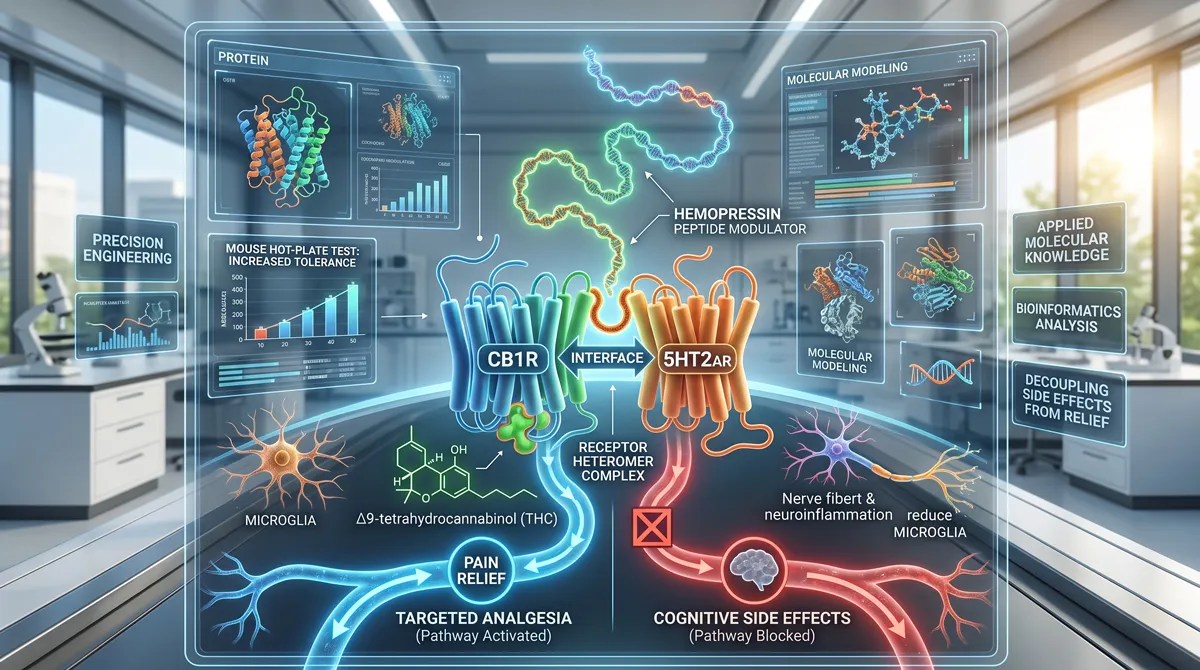
Peptides act as molecular modulators on G-Protein-Coupled Receptors (GPCRs), altering cannabinoid signaling pathways to isolate therapeutic pain relief from unwanted cognitive side effects.
G-Protein-Coupled Receptors (GPCRs) and Signaling Pathways
At the heart of this interaction are G-protein-coupled receptors (GPCRs). These proteins act as sensory gates on the surface of cells, detecting external signals and triggering internal responses. Cannabinoid receptors, specifically CB1R, are prominent GPCRs. Understanding how these receptors change shape upon binding with a ligand is the key to controlling their signaling pathways.
The Role of Receptor Heteromers: The CB1R-5HT2AR Complex
One of the most profound discoveries in recent years is the existence of receptor heteromers (a heteromer is a chemical or biological structure made of at least two different parts or subunits). Specifically, the CB1R-5HT2AR complex has been identified as a “culprit” in THC-induced memory loss. When CB1R (the cannabinoid receptor) binds to 5HT2AR (a serotonin receptor) to form a heteromer, the activation of the receptor by THC triggers a pathway that leads to cognitive impairment. By disrupting this specific heteromer interface using targeted peptides, scientists can decouple pain relief from cognitive disruption.
Cannabinoid Receptor Signaling: cAMP, Phospholipase C, and Intracellular Responses
When a ligand activates a GPCR, it initiates downstream cascades such as the modulation of cyclic AMP (cAMP) levels or the activation of phospholipase C. These signals translate extracellular information into intracellular actions. Peptides can influence these pathways by preventing certain “crosstalk” between receptors, ensuring that only the desired physiological response—such as analgesia—is amplified, while secondary, adverse signals are suppressed.
Spotlight on Hemopressin Peptides: Nature’s Cannabinoid Modulators
What Are Hemopressin Peptides? (VD-Hp, RVD-Hp, and NFKF)
Hemopressin and its related derivatives, such as VD-Hp and RVD-Hp, are peptides derived from hemoglobin. These endogenous molecules possess the unique ability to act as allosteric modulators of the CB1 receptor. Unlike THC, which acts as a full or partial agonist, these peptides can act as inverse agonists, selectively fine-tuning receptor sensitivity in ways that synthetic compounds cannot mimic.
Hemoglobin-Derived Peptides as Endogenous Ligands
The discovery that hemoglobin—typically known for oxygen transport—contains fragments that interact with cannabinoid receptors highlights the evolutionary complexity of our biological systems. These peptides function as natural “brakes” or “accelerators” within the ECS, providing a built-in mechanism for the body to manage its own pain-signaling information without the need for external, exogenous substances.
Biosynthesis and the Secretory Pathways of Intracellular Peptides
The synthesis of these peptides occurs via specific enzymatic cleavage of the parent protein. Understanding the secretory pathways of these molecules allows researchers to envision therapies that stimulate the body’s endogenous production of these regulatory peptides, effectively utilizing the body’s own internal pharmacy to support balance.
The Synergy of Analgesia: Rethinking Pain Management
Beyond Traditional Pharmaceuticals: Peptides and Cannabinoid Signaling
The current reliance on pharmaceuticals for chronic pain often involves systemic side effects that diminish a patient’s quality of life. By integrating peptide-based modulation with cannabinoid therapy, we can focus on the specific neuronal circuits involved in pain perception. This approach allows for potent analgesia that bypasses the non-specific, global effects of traditional medications.
Selective Targeting: Achieving Analgesia Without Cognitive Side Effects
The ultimate goal of this research is the dissociation of analgesic efficacy from psychoactive or amnestic effects. By using peptides to selectively interfere with the CB1R-5HT2AR heteromer, researchers have successfully demonstrated in experimental models that pain relief can be achieved while leaving memory and cognition intact. This represents a seismic shift in how we perceive the potential of cannabis-related therapies.
Evidence from the Bench: Mouse Models and the Hot-Plate Test
The validity of this approach has been bolstered by significant data from mouse models. In the standard “hot-plate test”—a traditional method for assessing pain thresholds—mice treated with a combination of cannabinoids and specific interfering peptides exhibited a marked increase in pain tolerance. Crucially, these mice performed significantly better on spatial memory tasks compared to those treated with THC alone, providing strong evidence for the viability of this synergistic model.
Neurological Impact: Neuroinflammation and Cognitive Health
Peptides as Molecular Chaperones for the Central Nervous System
Beyond pain, peptides can act as molecular chaperones, assisting in the proper folding and trafficking of receptors within the central nervous system. This support is vital for maintaining the structural integrity of neurons and the efficiency of synaptic transmission, particularly in environments of high neuroinflammation.
Modulating Microglial Cell Migration and Neuro-Immune Responses
Microglia are the immune cells of the brain. Chronic neuroinflammation involves the aberrant migration and activation of these cells. Peptides that modulate cannabinoid signaling can serve to dampen this inflammatory response, effectively acting as neuroprotective agents that preserve long-term cognitive health.
The Role of CB2 Receptors in Reducing Neuroinflammation
While CB1 receptors are associated with neuronal signaling, CB2 receptors are primarily expressed in immune cells, including microglia. Modulating the CB2 receptor through peptide-cannabinoid synergy offers a targeted way to reduce neuroinflammation, providing a dual-action strategy that addresses both the immune and neurological components of chronic pain and degeneration.
Overcoming the “Cannabis Problem”: Enhancing Efficacy while Reducing Side Effects
The Limitations of Δ9-Tetrahydrocannabinol (THC) and CBD Isolates
Broad-spectrum cannabis extracts and isolated cannabinoids like CBD and THC often fail because they are “dirty” ligands; they interact with too many receptor targets across the entire central nervous system. This lack of selectivity is what drives the “cannabis problem”—the requirement to choose between relief and sobriety.
How Peptides Mitigate Memory Impairment and Cognitive Side Effects
By utilizing peptides to selectively block the pathways that lead to memory impairment, we move away from the “all-or-nothing” nature of cannabis consumption. This precision allows for the therapeutic benefits to be harvested while the negative side effects are mitigated at the molecular level, creating a more sustainable model for long-term patient support.
Precision Engineering vs. The Traditional Entourage Effect
While the “entourage effect”—the theory that botanical compounds work better together than alone—is a staple of traditional herbal medicine, it is largely accidental. Peptide engineering replaces this accidental synergy with intentional, calculated molecular design. It is the evolution of the entourage effect into a controlled, replicable clinical discipline.
From Ancient Wisdom to Molecular Pharmacology
The Evolution of Natural Products: Lessons from Ayurvedic and Chinese Medicine
Ancient traditions have long utilized plants to balance the body. Today, we are validating those ancient observations through the lens of modern molecular pharmacology. By identifying the specific peptides that may naturally occur in the synergy of herbal preparations, we can isolate and refine these components to create more effective, consistent nutraceuticals.
Translating Botanical Synergies into Targeted Nutraceuticals
The future of the wellness industry lies in the translation of these complex interactions into standardized, high-precision products. By moving beyond raw plant material to peptide-enhanced formulations, we can ensure that patients receive a consistent, effective dose that respects the biological complexity of the ECS.
The Role of Peptides in the Future of the Cannabis Industry
As the cannabis industry matures, the focus will inevitably shift toward efficacy and safety. Peptides represent the next frontier of this maturity. Companies that invest in the research of receptor heteromers and peptide modulation will lead the market by offering products that are not just “natural,” but scientifically optimized for specific human functions.
Research Methodologies and Clinical Validation
To move this technology from the laboratory to the pharmacy, rigorous research methodologies are required. This includes the continued use of advanced molecular dynamics simulations to predict how peptides affect GPCR conformational changes, followed by longitudinal in vivo studies. Clinical validation will depend on our ability to demonstrate that the human blood-brain barrier can be effectively navigated by these peptides, ensuring that the therapeutic payload reaches its target in a timely and safe manner. As we continue to bridge the gap between bench-top discovery and human clinical application, the partnership between peptide science and cannabinoid research will remain a cornerstone of 21st-century medicine.
Conclusion
The synergy between peptides and cannabinoids represents a paradigm shift in how we manage complex conditions like chronic pain and neuroinflammation. By moving from the crude application of botanical extracts to the precision engineering of receptor-specific modulators, we are unlocking a new era of medical capability.
The molecular machinery described here involves manipulating GPCR heteromers. This method provides a clear, evidence-based way to achieve therapeutic relief without harmful side effects that have limited cannabis-based treatments. As researchers continue to refine these peptide-cannabinoid interactions, the potential for personalized, non-intoxicating, and highly effective therapies becomes increasingly clear.
For the industry and for patients alike, the integration of these molecular tools will be the defining challenge and opportunity of the coming decade. Future efforts should prioritize the translation of successful mouse model data into human-centric clinical trials, ensuring that the promise of this molecular synergy is realized in a practical, accessible, and safe clinical format. By focusing on the intersection of ancient wisdom and modern precision, we are building a more sophisticated, effective, and humane future for medicine.
Jason Liss — Co-Founder & Chief Formulator
As a Co-Founder of Wellspring CBD, Jason has been an advocate and pioneer in the cannabis and hemp industries since 1996. Passionate about helping people achieve better health through unique natural supplements, Jason uses his decades of experience to guide readers toward effective wellness solutions.
In this guide
- 01 Understanding the Intersection of Peptides and the Endocannabinoid System (ECS)
- 02 The Molecular Machinery: How Peptides and Cannabinoids Interact
- 03 Spotlight on Hemopressin Peptides: Nature’s Cannabinoid Modulators
- 04 The Synergy of Analgesia: Rethinking Pain Management
- 05 Neurological Impact: Neuroinflammation and Cognitive Health
- 06 Overcoming the “Cannabis Problem”: Enhancing Efficacy while Reducing Side Effects
- 07 From Ancient Wisdom to Molecular Pharmacology
- 08 Research Methodologies and Clinical Validation
- 09 Conclusion
Scroll to read · tap a topic to jump



🌱 New Here? First Order
Take 40% Off Your First Order
Join the Wellspring Journal for honest CBD education — enter your name and email to unlock an exclusive first-order code. Instant, no spam, one-click unsubscribe.
🔒 Instant Code
🌿 Zero Spam
✉️ 1-Click Unsubscribe
🌴 90-Day Promise


Discussion