


🔒 Secure Checkout
·
90-Day Promise
·
Free Shipping $75+
🌱 CBD & Wellness Guides
 · Co-Founder & Chief Formulator
Honest Guidance · Daily Routines · Plant Wellness
CBD Dosage Calculator for Dogs and Cats by Weight (with Drop-Chart)
· Co-Founder & Chief Formulator
When a beloved dog begins hesitating before jumping into the car, or an aging cat starts struggling to reach the windowsill, pet parents naturally search for gentle, plant-based remedies. Over the last several years, hemp-derived cannabidiol (CBD) has emerged as one of the most trusted veterinary supplements for easing joint stiffness, soothing storm anxiety, and supporting vitality in senior companion animals.
Yet when pet owners unbox their first bottle of pet CBD oil, they are frequently confronted with vague instructions: “Give 1/2 to 1 dropper daily.”
This generic guidance is not only unhelpful—it can be counterproductive. Pets are not tiny humans. A 7-pound Chihuahua, a 60-pound Labrador Retriever, and an 8-pound domestic shorthair cat possess vastly different metabolic rates, receptor distributions, and organ clearance capacities. Giving a toy poodle a full dropper intended for a German Shepherd will induce lethargy, while giving a 90-pound Mastiff three drops of diluted oil will deliver zero mobility relief.
Precision dosing is the key to unlocking the benefits of pet CBD safely and economically.
Below, we explain the canine and feline Endocannabinoid System, outline the standard veterinary weight formula (0.2 mg to 0.5 mg per pound), provide a complete master drop-chart across bottle potencies, examine unique feline metabolic safety rules, and break down the clinical science behind companion animal wellness.
The Science: How Pets Process Cannabinoids Differently Than Humans
Like humans, all vertebrate animals—including dogs, cats, and horses—possess an Endocannabinoid System (ECS). The ECS consists of cellular receptors (CB1 and CB2), endogenous chemical messengers, and enzymes that regulate immune balance, pain signaling, mood, and joint flexibility.
However, veterinary pharmacology reveals two critical distinctions between pet physiology and human biology:
1. Canine CB1 Receptor Density and “Static Ataxia”
Canine brains possess a significantly higher concentration of cannabinoid type 1 (CB1) receptors in the cerebellum and brainstem than human brains.
Because of this heightened neuroreceptor density, dogs are extraordinarily sensitive to tetrahydrocannabinol (THC). Exposure to even modest amounts of Delta-9 THC can trigger a temporary but terrifying neurological reaction known as static ataxia—characterized by staggering, muscle tremors, dilated pupils, urinary incontinence, and sensory disorientation.
For this reason, companion pets should always receive certified broad-spectrum or pure CBD isolate formulations with non-detectable (0.0% THC) verification.
2. Feline Glucuronidation Deficiencies
Cats are obligate carnivores with specialized liver physiology. Feline livers have a notable deficiency in glucuronyl transferase enzymes (specifically UGT1A6 and UGT1A9), which are responsible for metabolizing certain botanical phenols, essential oils, and synthetic flavorings.
While cats process pure cannabidiol safely, they cannot tolerate artificial flavorings, tea tree oil, citrus terpenes (limonene), or pine terpenes (pinene). Cat CBD should always feature an unflavored, pure organic MCT or hemp seed carrier base.
To learn more about feline health, review our essential guide on CBD for cats and critical pet safety.
The Veterinary Dosing Formula: Milligrams per Pound
Veterinary researchers and holistic practitioners calculate CBD servings based on the animal’s exact body weight and the severity of their symptoms.
The gold standard calculation uses a three-tier guideline:
[ LOW / WELLNESS TIER ]   ────> 0.2 mg of CBD per pound of body weight
[ MODERATE / MOBILITY ]   ────> 0.5 mg of CBD per pound of body weight
[ ADVANCED / CLINICAL ]   ────> 1.0 mg of CBD per pound of body weight
Tier 1: Low / Baseline Wellness (0.2 mg / lb)
- Primary Use: Daily vitality, minor situational stress (car rides, grooming visits, mild fireworks), young pet wellness.
- Formula: Weight in lbs × 0.2 = Daily Milligrams.
- Example: A 25 lb dog requires: 25 × 0.2 = 5 mg CBD daily.
Tier 2: Moderate Mobility & Anxiety (0.5 mg / lb)
- Primary Use: Morning joint stiffness, difficulty climbing stairs, persistent separation anxiety, senior dog cognitive support.
- Formula: Weight in lbs × 0.5 = Daily Milligrams.
- Example: A 50 lb dog requires: 50 × 0.5 = 25 mg CBD daily (often split into 12.5mg morning and 12.5mg evening).
Tier 3: Advanced / High-Discomfort (1.0 mg / lb)
- Primary Use: Severe mobility impairment, post-exercise recovery in working breeds, episodic flare-ups under veterinary supervision.
- Formula: Weight in lbs × 1.0 = Daily Milligrams.
- Example: An 80 lb dog requires: 80 × 1.0 = 80 mg CBD daily (split into two 40mg servings).
For a clinical look at real-world pet outcomes, see our overview of the top 5 benefits of CBD oils for pets.
Dropper Math: Understanding Milligrams per Drop
Liquid tinctures administered with a glass pipette provide the most precise, customizable way to dose companion animals.
In standard 30mL (1 oz) tincture bottles:
- 1 Full Dropper (filled to the 1.0 mL line) = approximately 30 drops.
The concentration of active cannabidiol per drop changes dramatically based on the total bottle strength:
| Bottle Strength (30mL Bottle) | CBD per Full Dropper (1.0 mL) | Estimated CBD per Single Drop | Best Pet Weight Range |
|---|---|---|---|
| 500 mg Bottle | ~16.7 mg CBD | ~0.55 mg per drop | Cats & Small Dogs (under 25 lbs) |
| 1,000 mg Bottle | ~33.3 mg CBD | ~1.10 mg per drop | Medium Dogs (25 to 60 lbs) |
| 3,000 mg Bottle | ~100.0 mg CBD | ~3.30 mg per drop | Large Breeds (60+ lbs) & Multi-Pet Homes |
Using the right concentration matters. If you try to give an 80-pound dog 40mg of CBD using a weak 500mg bottle, you will have to squeeze nearly two and a half full droppers into their mouth. Conversely, trying to dose an 8-pound cat using a concentrated 3,000mg bottle makes it almost impossible to measure out a tiny 1.5mg serving.
Master Pet Dosing Chart: Exact Drops by Pet Weight
Use this comprehensive lookup chart to identify your pet’s ideal starting milligrams and corresponding drop counts:
| Pet Weight (lbs) | Typical Pet Profile | Target Daily Dose (Moderate: ~0.5mg/lb) | Drops from 500mg Bottle (0.55 mg/drop) | Drops from 1,000mg Bottle (1.10 mg/drop) | Drops from 3,000mg Bottle (3.30 mg/drop) |
|---|---|---|---|---|---|
| 5 lbs | Kitten, Toy Chihuahua | 1.0 to 2.5 mg | 2 to 4 drops | 1 to 2 drops | Not recommended (too potent) |
| 10 lbs | Adult Cat, Yorkie, Shih Tzu | 2.5 to 5.0 mg | 5 to 9 drops | 2 to 4 drops | 1 drop |
| 20 lbs | Pug, Frenchie, Beagle | 5.0 to 10.0 mg | 9 to 18 drops | 5 to 9 drops | 2 to 3 drops |
| 35 lbs | Cocker Spaniel, Corgi | 10.0 to 17.5 mg | 18 to 32 drops (~1 mL) | 9 to 16 drops | 3 to 5 drops |
| 50 lbs | Aussie, Border Collie | 15.0 to 25.0 mg | ~1.5 full droppers | 14 to 22 drops (~0.75 mL) | 5 to 8 drops |
| 70 lbs | Lab, Golden Retriever | 25.0 to 35.0 mg | ~2 full droppers | ~1 full dropper (1.0 mL) | 8 to 11 drops (~0.33 mL) |
| 90+ lbs | German Shepherd, Mastiff | 35.0 to 50.0 mg | Not practical | ~1.5 full droppers | 11 to 15 drops (~0.50 mL) |
Best Practice: Start at the lower end of the weight recommendation for the first three to five days. Observe your pet’s energy, gait, and demeanor before stepping up the dose.
Administration Techniques: How to Give CBD to Picky Pets
Even the most effective formula won’t work if your pet spits it out onto the rug. Here are three proven administration methods ranked by bioavailability:
Method 1: Direct Sublingual (Transmucosal) Absorption (Most Effective)
Gently lift your dog or cat’s upper lip and dispense the measured drops directly onto their gums or inside the cheek pouch. Active cannabinoids absorb directly through oral mucosal capillaries, bypassing digestive acids and delivering noticeable comfort within 20 to 30 minutes.
Method 2: Porous Crunchy Treats
Dispense drops directly onto a porous, crunchy dog biscuit or freeze-dried meat treat. Allow the oil to soak into the treat for 60 seconds before offering it to your pet. This masks the texture while ensuring the full serving is consumed. For kitchen inspiration, explore our collection of calming CBD pet treat recipes.
Method 3: Food Topper (Mixed with Meals)
Mix the measured drops into a spoonful of wet food, bone broth, or plain unsweetened pumpkin purée. Because dietary fats aid cannabinoid digestion, mixing CBD with regular meals ensures smooth, steady absorption over 45 to 60 minutes.
For senior felines with sensitive palates, read our guide on CBD cat treats and oils for aging cats.
What the Clinical Research Shows: The Cornell Veterinary Study
Pet parents do not have to rely on anecdotal stories to evaluate CBD safety and efficacy.
In a landmark clinical study conducted by the Cornell University College of Veterinary Medicine and published in Frontiers in Veterinary Science, researchers evaluated client-owned dogs diagnosed with chronic osteoarthritis:
- Study Design: A randomized, double-blind, placebo-controlled crossover study administering 2 mg of CBD per kilogram of body weight (approx. 0.9 mg/lb) twice daily.
- Clinical Results: Veterinarians and dog owners reported a statistically significant decrease in pain scores and a clinically significant increase in daily physical activity.
- Safety Profile: No adverse neurological side effects were observed, and liver enzymes remained within normal biological baseline ranges.
This research validated what holistic veterinarians had observed for years: when administered at proper weight-calibrated potencies, clean hemp extract offers profound physical support for companion animals.
The Wellspring Pet Standard
At Wellspring CBD, we formulate pet products with the exact same laboratory rigor and clinical purity we demand for human supplements. We never repurpose low-grade agricultural waste oils or hide behind artificial bacon flavorings.
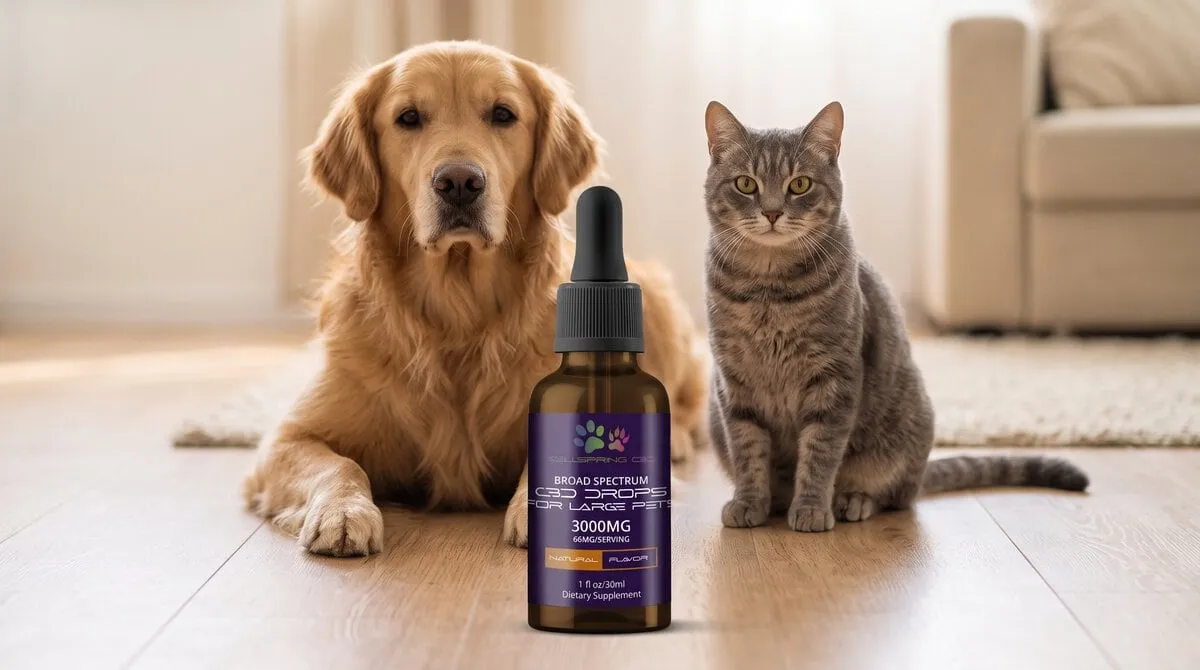
Our broad spectrum CBD oil for pets is crafted from certified US-grown hemp suspended in human-grade organic coconut MCT oil. Formulated in Cheyenne, Wyoming, every batch is verified by accredited third-party ISO 17025 laboratories to guarantee 0.0% THC purity and confirm zero heavy metals, microbial pathogens, or residual solvents.
Explore our complete CBD for pets collection today and help your four-legged family member move and rest with ease, backed by our 90-Day Satisfaction Promise.
Frequently Asked Questions
Can a dog or cat overdose on CBD oil?
Cannabidiol has a remarkably high safety margin. In clinical trials, pets given ten times standard therapeutic doses exhibited mild temporary lethargy, diarrhea, or dry mouth, but no life-threatening toxicity. However, toxicity can occur if a pet ingests human products containing THC, xylitol (birch sugar), chocolate, or essential oils. Always keep human edibles securely stored away from curious pets.
How long does it take for pet CBD drops to start working?
When administered directly onto gums or tongue, sublingual absorption begins within 20 to 30 minutes. When mixed into kibble or swallowed with treats, initial onset requires 45 to 60 minutes as the compound moves through digestion. Peak physical comfort typically sustains for 4 to 8 hours.
Can I give my pet human CBD oil?
Only if the human formula meets strict veterinary standards: it must be unflavored, alcohol-free, verified 0.0% THC on a third-party lab report, and formulated with clean organic coconut MCT or hemp seed oil. Never give pets human CBD products that contain sweeteners, essential oils, or trace THC.
How often should I give my pet CBD drops?
Because cannabinoids are metabolized throughout the day, the most effective routine is twice-daily administration, spaced approximately 8 to 12 hours apart (e.g., once with breakfast and once with dinner). This maintains steady endocannabinoid tone across your pet’s joints and nervous system around the clock.
🌿 Formulations in This Guide
Recommended Products for Your Routine
Organic US-grown hemp, batch Certificate of Analysis published on each page, backed by our 90-Day Money-Back Promise.


Jason Liss — Co-Founder & Chief Formulator
As a Co-Founder of Wellspring CBD, Jason has been an advocate and pioneer in the cannabis and hemp industries since 1996. Passionate about helping people achieve better health through unique natural supplements, Jason uses his decades of experience to guide readers toward effective wellness solutions.
In this guide
- 01 The Science: How Pets Process Cannabinoids Differently Than Humans
- 02 The Veterinary Dosing Formula: Milligrams per Pound
- 03 Dropper Math: Understanding Milligrams per Drop
- 04 Master Pet Dosing Chart: Exact Drops by Pet Weight
- 05 Administration Techniques: How to Give CBD to Picky Pets
- 06 What the Clinical Research Shows: The Cornell Veterinary Study
- 07 The Wellspring Pet Standard
- 08 Frequently Asked Questions
Scroll to read · tap a topic to jump

🌱 New Here? First Order
Take 40% Off Your First Order
Join the Wellspring Journal for honest CBD education — enter your name and email to unlock an exclusive first-order code. Instant, no spam, one-click unsubscribe.
🔒 Instant Code
🌿 Zero Spam
✉️ 1-Click Unsubscribe
🌴 90-Day Promise
Discussion