

🔒 Secure Checkout
·
90-Day Promise
·
Free Shipping $75+
🌱 CBD & Wellness Guides
 · Co-Founder & Chief Formulator
Honest Guidance · Daily Routines · Plant Wellness
CBD vs. Melatonin for Sleep: Which One Should You Choose?
· Co-Founder & Chief Formulator
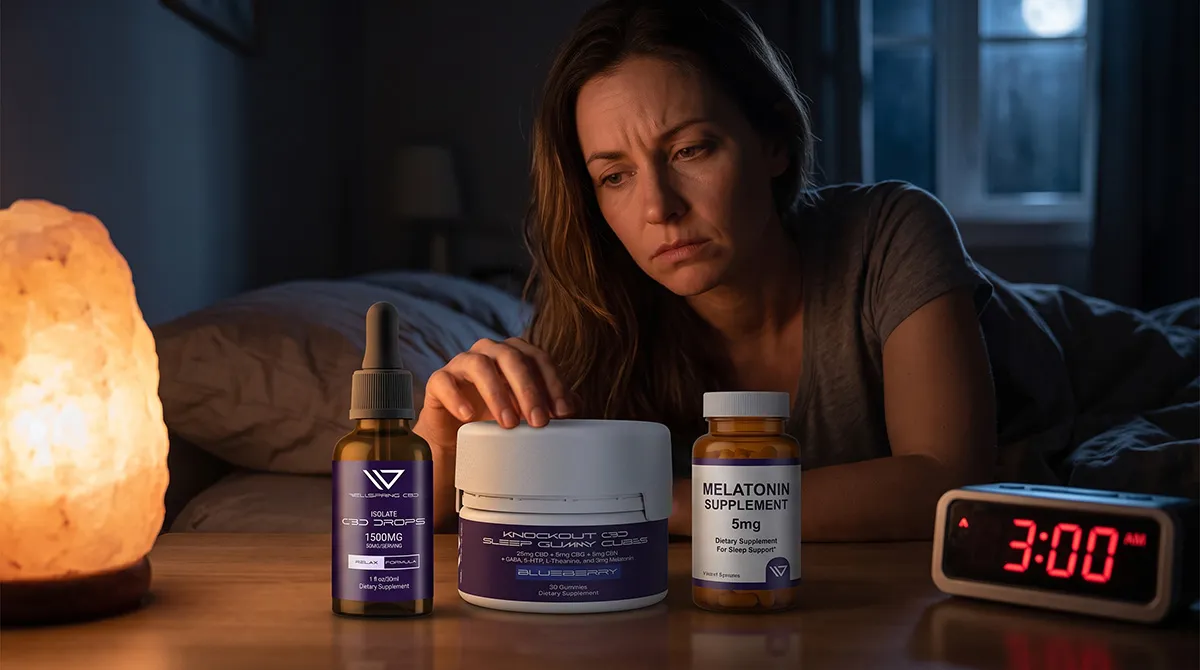
It is 3:00 AM, and you are staring at the ceiling again. The frustration of being unable to drift off is often worse than the fatigue itself. If you find yourself frequently searching for a reliable sleep aid, you have likely encountered two heavy hitters: melatonin and CBD.
While both are popular, they operate through fundamentally different biological pathways. Understanding these differences is the key to moving from restless nights to restorative rest.
💡 Direct Answer: CBD & CBN vs. Melatonin for Sleep — Which Is Better?
Melatonin is an endocrine hormone ideal for short-term circadian shifts like jet lag or shift work. However, for chronic restlessness, racing thoughts, or middle-of-the-night waking, CBD and CBN are generally superior. Cannabinoids interact with the endocannabinoid system and GABA pathways to calm central nervous system arousal, relieve physical tension, and promote deep, restorative sleep—all without the morning grogginess, vivid nightmares, or hormonal dependence frequently caused by synthetic melatonin.
CBD & CBN vs. Melatonin: Side-by-Side Comparison
| Feature | Melatonin | CBD & CBN Cannabinoids |
|---|---|---|
| Primary Mechanism | Signals the brain’s circadian clock that it is nighttime (hormonal trigger) | Calms nervous system arousal via ECS & GABA receptors (neurological relaxation) |
| Best Used For | Jet lag, shift work, and resetting circadian rhythm | Racing thoughts, physical tension, staying asleep through the night |
| Morning Grogginess | Common (“melatonin hangover” from slow clearance) | Very rare; non-sedative relaxation clears cleanly |
| Sleep Architecture | May alter natural REM cycles in high doses | Supports slow-wave deep sleep and natural sleep architecture |
| Habituation Risk | May downregulate natural melatonin production with nightly use | Non-habit-forming; maintains natural hormonal balance |
| Ideal Timing | 30–60 minutes before desired bedtime | 30–45 minutes (drops) or 60 minutes (edibles) |
Understanding the Biological Difference: A Hormone vs. a Modulator
To choose the right tool for your specific sleep struggle, you must first understand how these two substances communicate with your body.
Melatonin: The Master Regulator of the Circadian Rhythm
Melatonin is a naturally occurring hormone produced by the pineal gland. Its primary role is to act as a chemical signal to your brain that it is time to prepare for rest. By aligning your internal circadian rhythm with the external environment, melatonin effectively acts as the conductor of your sleep-wake orchestra.
CBD: How the Endocannabinoid System Influences Relaxation
Conversely, CBD (cannabidiol) is a non-psychoactive cannabinoid derived from hemp plants. It functions as a modulator rather than a hormone. It interacts with the endocannabinoid system (ECS), a complex cell-signaling network involved in regulating mood, pain, and immune response. By influencing these receptors, CBD promotes a state of calm and systemic relaxation that can make it easier to drift off.
Why Your Choice Depends on the “Why” Behind Your Sleeplessness
Your choice should be dictated by your specific symptoms. If you struggle with jet lag or a shifted schedule, you need the “clock-setter” (melatonin). If your struggle is rooted in racing thoughts or physical tension, you likely need the “systemic-soother” (CBD).
Melatonin for the “Biological Clock”: Resetting Your Sleep-Wake Cycle
The Role of the Pineal Gland and Light Sensitivity
The pineal gland is highly sensitive to light. During the day, sunlight suppresses melatonin production. As darkness falls, production increases, signaling to your body that it is time to wind down. Disruptions—such as late-night screen exposure—can inhibit this process, leading to insomnia.
When Melatonin Shines: Jet Lag, Shift Work, and Sleep Onset Latency
Melatonin is most effective when your internal clock is out of sync with your environment. Studies, including meta-analyses by the National Library of Medicine, suggest that it is particularly beneficial for reducing “sleep onset latency”—the time it takes to fall asleep—especially in cases of jet lag or irregular shift work.
Potential Drawbacks: Morning Grogginess and “The Melatonin Hangover”
While powerful, melatonin is not a sedative. Taking too much can lead to next-day drowsiness, often called a “melatonin hangover.” It is a delicate signaling molecule; more is rarely better.
CBD for the “Busy Mind”: Addressing the Root Causes of Insomnia
Reducing Anxious Thoughts and Physical Tension via the Parasympathetic Nervous System
Many sleep disorders are exacerbated by high cortisol levels or an overactive nervous system. CBD helps shift the body into a parasympathetic state, quieting the “busy brain” and reducing anxiety that keeps you alert when you should be resting.
CBD’s Role in Managing Discomfort and Inflammatory Responses
For many, the physical barrier to sleep is discomfort or nagging inflammation. By supporting the ECS, CBD may help manage these physiological stressors, allowing the body to reach the physical comfort necessary for deep sleep.
Understanding CBD Types: Full-Spectrum, Broad-Spectrum, and CBD PM Formulations
When shopping for gummies or oils, you will encounter different varieties. Full-spectrum contains all compounds found in cannabis (including trace THC), while broad-spectrum removes THC. “CBD PM” formulations often combine CBD with other botanicals like melatonin or valerian root for a multi-layered approach to rest.
Decision Support: Which Supplement Fits Your Sleep Profile?
The “Jet Lagged Traveler”: Why Melatonin is the Gold Standard for Circadian Shifts
If you are traveling across time zones or rotating shifts, melatonin is your primary tool. It provides the specific hormonal nudge required to shift your biological clock.
The “Anxious Overthinker”: How CBD Targets the Stress-Sleep Connection
If your issue is mental stimulation—that internal monologue that won’t turn off—CBD is generally the superior choice for promoting the relaxation required to disengage from the day.
The “Pain-Restricted Sleeper”: Using Cannabidiol to Manage Nighttime Discomfort
If your sleep is interrupted by physical aches, the anti-inflammatory and soothing properties of CBD make it the more effective option for sustained comfort.
Comparison Table: Sleep Onset vs. Sleep Maintenance
| Feature | Melatonin | CBD |
|---|---|---|
| Primary Mechanism | Hormonal Signaling | ECS Modulation |
| Best For | Onset/Circadian Rhythm | Relaxation/Maintenance |
| Target Audience | Travelers/Shift Workers | Anxious/Tense Sleepers |
| Common Form | Supplements/Gummies | Oils/Gummies/Topicals |
Can You Take CBD and Melatonin Together?
The Potential for Synergy: Enhancing the Entourage Effect
The “Entourage Effect” suggests that different compounds may work better together than alone. Combining CBD and melatonin can offer a dual-action approach: CBD addresses the anxiety and physical tension, while melatonin provides the timing signal for sleep onset.
Exploring Combined Botanicals: Adding Valerian Root, Magnesium, and Chamomile
Many modern sleep aids now integrate CBD or melatonin with magnesium or herbal extracts like chamomile, which further encourages the sleep quality you seek by relaxing muscles and lowering cortisol.
Safety First: Balancing Dosages and Avoiding Over-Sedation
When combining these, start with the lowest possible dose. Because both affect your nervous system, tracking your dosage carefully is essential to avoid unwanted grogginess or over-sedation.
Science and Safety: What the Research Says
Evaluating the Evidence: National Library of Medicine Meta-Analysis Findings
Research suggests melatonin is highly effective for shortening sleep onset time. CBD research is still evolving, but clinical data increasingly supports its efficacy in reducing situational anxiety and improving subjective sleep satisfaction.
Side Effects and Long-Term Considerations for Melatonin Use
Because melatonin is a hormone, long-term daily use should be discussed with a doctor to ensure it does not interfere with your body’s natural production.
Potential Drug Interactions: Consulting the Pharmacy and Your Doctor
Both CBD and melatonin can interact with medications. CBD, in particular, affects how the liver processes certain drugs. Always consult a professional before adding these to your regimen.
How to Shop for Sleep Supplements: Quality and Transparency
The Importance of Third-Party Testing and Certificates of Analysis (COAs)
Never purchase a hemp-derived product without a Certificate of Analysis (COA). This document confirms that the product contains what the label claims and is free from contaminants like heavy metals or pesticides.
Navigating the Legal Landscape: The Agriculture Improvement Act and Hemp-Derived Products
Under the 2018 Agriculture Improvement Act, hemp-derived products containing less than 0.3% THC are federally legal. This ensures you can access high-quality products from reputable sources.
Identifying Red Flags: Synthetic Copies vs. Natural Hemp Plants
Be wary of products that make wild medical claims or lack transparent testing. Authentic brands are proud of their COAs and emphasize their extraction methods from high-quality hemp plants.
🌙 Restorative, Melatonin-Free Sleep Formulations
Formulated to quiet the mind, ease muscular tension, and support deep sleep with zero morning brain fog:
100% Melatonin-Free • 30 Count
Gentle Sleep 50mg CBD/CBN/CBG Gummies
30mg CBD + 10mg CBN + 10mg CBG infused with organic lemon balm & passion flower. Eases you into deep slumber with zero melatonin, morning brain fog, or hormonal habituation.
$39.95
View Gentle Sleep →
Sublingual Drops • Fast Acting
High-Potency CBN Isolate Drops
Pure, concentrated cannabinol in organic coconut MCT oil. Absorbs sublingually in 15–30 minutes for nights when you need fast, reliable relief.
$49.95
View CBN Drops →
🚚 Free Shipping on orders $75+
🛡️ 90-Day Money-Back Guarantee
🔬 3rd-Party ISO Lab Tested
Conclusion
Finding your path to better rest requires a shift in mindset. Rather than searching for a “miracle pill,” view these supplements as tools to be used alongside a consistent sleep hygiene routine. Whether you choose melatonin to reset your internal clock or CBD to calm a restless mind, success lies in understanding the “why” behind your sleep deficit.
If you are struggling with consistent sleep disorders, always start by consulting a physician, and remember that real, restorative rest is usually the result of a holistic approach: managing your environment, reducing stress, and using high-quality, third-party tested tools as your final support.
Frequently Asked Questions: CBD & CBN vs. Melatonin
Can you take CBD and melatonin together?
Yes. Combining low-dose melatonin (1mg to 3mg) with CBD (20mg to 40mg) is generally safe and synergistic. Melatonin prompts the initial biological signal to sleep, while CBD reduces anxiety and physical tension, helping you stay asleep through the night. However, many people find that starting with cannabinoids alone delivers restorative rest without the morning grogginess common to synthetic melatonin.
Why does melatonin cause morning grogginess while CBD and CBN do not?
Commercial melatonin supplements frequently contain doses far exceeding the body’s natural physiological production (3mg to 10mg vs. the 0.3mg natural burst). Excess melatonin lingers in the bloodstream well past morning waking hours, causing a hormonal ‘hangover.’ CBD and CBN modulate neurotransmitter receptors (such as GABA and 5-HT1A) to reduce nervous system arousal rather than sedating the brain, allowing you to wake up clear-headed.
How does CBN differ from CBD for sleep?
While CBD is famous for calming generalized anxiety, stress, and systemic inflammation, CBN (cannabinol) has a stronger affinity for CB2 receptors and produces a more noticeable body-relaxing effect. When paired together, CBD calms a busy mind while CBN facilitates deep physical relaxation and fewer nighttime awakenings.
How long before bed should you take CBD or CBN?
Take sublingual CBD or CBN drops 30 to 45 minutes before sleep for rapid oral capillary absorption. If using gummies or capsules, consume them 45 to 60 minutes before bedtime to accommodate digestive absorption through the liver.
Jason Liss — Co-Founder & Chief Formulator
As a Co-Founder of Wellspring CBD, Jason has been an advocate and pioneer in the cannabis and hemp industries since 1996. Passionate about helping people achieve better health through unique natural supplements, Jason uses his decades of experience to guide readers toward effective wellness solutions.
In this guide
- 01 Understanding the Biological Difference: A Hormone vs. a Modulator
- 02 Melatonin for the “Biological Clock”: Resetting Your Sleep-Wake Cycle
- 03 CBD for the “Busy Mind”: Addressing the Root Causes of Insomnia
- 04 Decision Support: Which Supplement Fits Your Sleep Profile?
- 05 Can You Take CBD and Melatonin Together?
- 06 Science and Safety: What the Research Says
- 07 How to Shop for Sleep Supplements: Quality and Transparency
- 08 Conclusion
- 09 Frequently Asked Questions: CBD & CBN vs. Melatonin
Scroll to read · tap a topic to jump



🌱 New Here? First Order
Take 40% Off Your First Order
Join the Wellspring Journal for honest CBD education — enter your name and email to unlock an exclusive first-order code. Instant, no spam, one-click unsubscribe.
🔒 Instant Code
🌿 Zero Spam
✉️ 1-Click Unsubscribe
🌴 90-Day Promise
Discussion