

🔒 Secure Checkout
·
90-Day Promise
·
Free Shipping $75+
🌱 Cannabinoids Explained
 · Co-Founder & Chief Formulator
Honest Guidance · Daily Routines · Plant Wellness
Volatile Sulfur Compounds in Cannabis: The Science Behind the Dank Aroma
· Co-Founder & Chief Formulator
For years, the Cannabis industry has relied on a limited “terpene framework” to explain the aromatic diversity of cannabis flowers. We are taught that high limonene equates to citrus, while myrcene promises earthy, herbal notes. However, any seasoned connoisseur has encountered two distinct cannabis cultivars with nearly identical terpene profiles that possess radically different sensory signatures.
One might smell like sweet berries, while the other reeks of intense, nose-stinging skunk or gasoline. This discrepancy, long dismissed as a mystery, is finally being unmasked by the science of volatile sulfur compounds (VSCs).
Beyond Terpenes: The Missing Link in Cannabis Aroma
Understanding Cannabis Aroma: Role of Volatile Sulfur Compounds
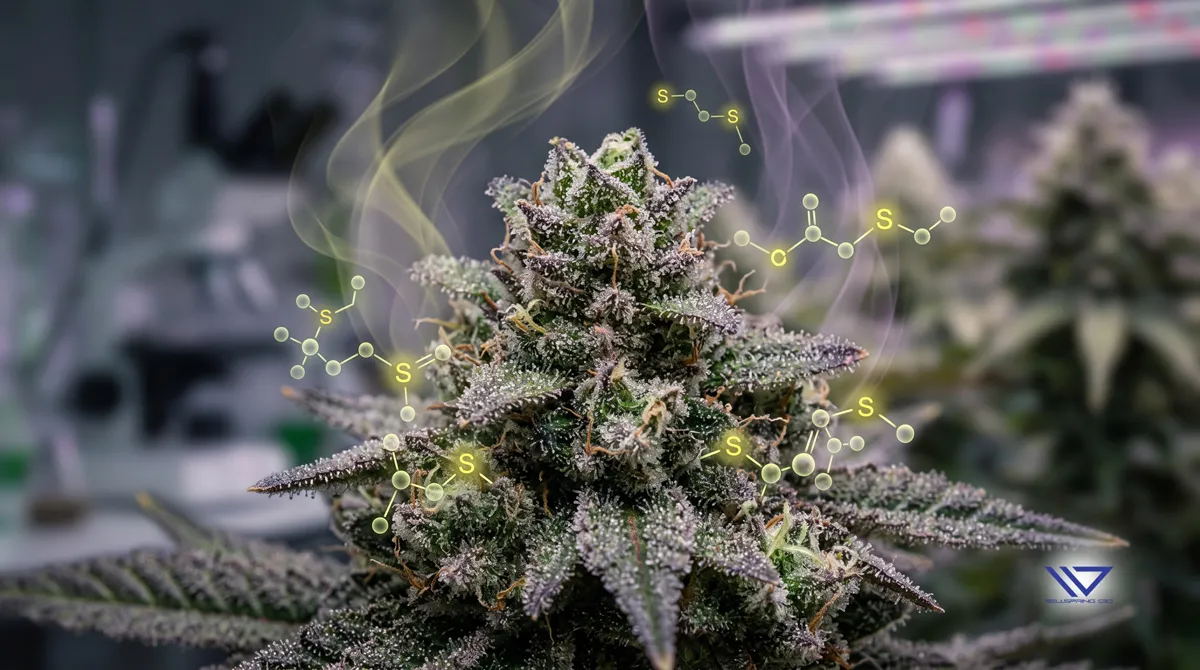
The usual story about terpenes is not complete. While terpenes make up the bulk of the aromatic mass, trace amounts of volatile organic compounds—specifically sulfur-based ones—are responsible for the overpowering “dank” and skunky notes that define premium-grade flower. Discovering volatile sulfur compounds (VSCs) has fundamentally changed how we understand cannabis smell.
The “Terpene Fallacy”: Why Myrcene and Caryophyllene Don’t Smell Like Skunk
The traditional terpene narrative is fundamentally incomplete. Terpenes are essential to the broad aroma of Cannabis sativa, but they are insufficient to explain the pungent qualities that define top-tier flower. Relying solely on terpenes ignores the “terpene fallacy”—the misconception that these hydrocarbons account for every nuance of a cultivar’s scent profile. While terpenes provide the fruity, piney, or floral backbone, they lack the chemical potency to produce the sulfurous, petroleum-like notes that connoisseurs crave.
Defining Volatile Sulfur Compounds (VSCs) and Their Potency
VSCs are a class of low-molecular-weight sulfur compounds. Unlike terpenes, which are detected in milligram-per-gram (mg/g) concentrations, VSCs are active at parts-per-billion (ppb) levels. This extreme potency allows them to dominate the sensory experience even when present in trace amounts. They are the chemical equivalent of a drop of ink in a glass of water; their influence on the aromatic “color” of the flower is disproportionately massive compared to their physical mass.
The Discovery of 3-methyl-2-butene-1-thiol (3-MBT) in Cannabis Sativa L.
The 2021 study by Oswald et al. marked a turning point in cannabis science. Finding this compound gave the first clear proof that cannabis gets its unique, strong smells from these sulfur compounds. This is much like the chemistry found in hops or coffee, where thiols dictate the “skunked” or roasted character of the final product.
The Prenyl Functional Group: The Molecular Key to the Skunky Aroma
The secret to the “gassy” nature of modern cannabis lies in the prenyl functional group (3-methylbut-2-en-1-yl). This structural component is the molecular key that links these sulfur compounds to the skunky aroma. When sulfur atoms are attached to a prenyl moiety, the resulting compounds become incredibly odorous and chemically reactive. These prenylated volatile sulfur compounds are the hallmark of high-quality, pungent cultivars that leave a lingering aroma in the air long after the flower has been handled.
VSC3 through VSC7: Mapping the Cannasulfur Compound Family
Research has categorized a range of sulfur-based molecules, notably labeled VSC3 through VSC7. Scientists map these sulfur compounds to tell cultivars apart. Some have a simple “citrus-gas” smell. Others have a complex smell with garlic, onion, and tropical fruit notes.
The Chemical Relationship Between Cannabis, Garlic (Allicin), and Skunk Spray
The human nose is evolutionarily tuned to detect sulfur as a warning signal. This connection is not by chance. The chemicals that make garlic’s strong allicin are similar to how the cannabis plant makes its thiols. This evolutionary “mimicry” causes the strong smell that users call “dank.”
Integrating the Methylerythritol Phosphate (MEP) and Mevalonic Acid (MVA) Pathways
The synthesis of these compounds occurs primarily during the flowering stage. Plants use the MEP and MVA pathways, which are typically associated with terpene production, but redirect sulfur-containing precursors toward these unique VSC pathways.
The Role of Terpene Synthases and Nonterpenoid Compound Formation
While terpenes are synthesized by enzymes known as terpene synthases, the formation of nonterpenoid VSCs suggests that the plant’s genetic “instruction manual” is far more complex than previously assumed. These enzymes catalyze reactions that involve sulfur incorporation, turning basic building blocks into high-impact aromatics.
How the Flowering Stage Triggers VSC Production
VSC production is not a constant; it peaks during the latter half of the flowering stage. As the plant directs energy toward the development of cannabis flowers, it shifts its secondary metabolite output. This is why the most “dank” aromas often emerge in the final weeks of growth.
The “Gassy” Profile: Prenylated VSCs and the Petroleum-Citrus Aroma
The “gassy” or “diesel” profile is essentially a blend of limonene and specific prenylated VSCs. The limonene provides the light top note, while the prenylated volatile sulfur compounds act as the heavy, clinging base note.
Tropical Nuances: 3-mercaptohexan-1-ol (3-MH) and Exotic Fruit Descriptors
Not all sulfur compounds are “skunky.” Some, such as 3-mercaptohexan-1-ol (3-MH), contribute notes of tropical fruit and passionfruit. These aroma descriptors explain how certain cultivars can smell incredibly sweet while still possessing an underlying complexity.
Interplay with Esters: How VSCs and Flavorants Create “Exotic” Cultivars like Bacio Gelato
“Exotic” strains, such as Bacio Gelato, achieve their reputation through a perfect storm of esters, terpenes, and VSCs. The ester profile provides the sweetness of candy, while the VSCs provide a savory depth that prevents the aroma from becoming cloying.
The Limits of Standard GC-MS: Why Trace Concentrations Are Hard to Measure
Current Certificate of Analysis (COA) standards are failing consumers. Standard gas chromatography coupled with mass spectrometry is often designed to measure bulk chemical profiles. Because VSCs exist in the parts-per-billion range, they are often lost in the “noise,” leading to their exclusion from standardized testing.
Comprehensive 2D Gas Chromatography (GC × GC): The Science of Seeing the Invisible
The solution lies in comprehensive two-dimensional gas chromatography (GC × GC). This technique separates compounds in two distinct dimensions, vastly increasing the resolution of the analysis. It allows scientists to zoom in on those trace sulfur peaks that would otherwise remain hidden.
GC/GC 2D gas chromatography, also known as comprehensive two-dimensional gas chromatography (GC×GC), is an advanced analytical technique used to separate and analyze complex mixtures of volatile compounds. It involves the use of two different chromatographic columns with different stationary phases, allowing for enhanced separation efficiency and resolution compared to traditional one-dimensional gas chromatography (GC).
Here’s a basic overview of how GC×GC works:
- Two-Dimensional Separation: In GC×GC, a sample is first separated on the first column (1D), which is typically a non-polar or semi-polar column. The effluent from this column is rapidly introduced into a second column (2D) via a modulator. The second column usually has a different polarity or separation mechanism.
- Modulation: The modulator is a key component of GC×GC. It periodically collects fractions of effluent from the first column and injects them into the second column in quick succession. This allows the second column to separate compounds that elute closely together in the first dimension, effectively spreading out the chromatogram in a two-dimensional space.
- Data Output: The results from a GC×GC analysis are typically visualized as a two-dimensional plot, where the x-axis represents the retention time in the first dimension and the y-axis represents the retention time in the second dimension. Peaks in this plot provide a more detailed separation profile, making it easier to identify and quantify individual components, especially in complex mixtures.
- Applications: GC×GC is particularly useful in fields such as petrochemicals, environmental analysis, flavor and fragrance studies, and complex organic mixtures, where sample complexity requires advanced separation techniques.
GC×GC offers significant improvements in the analytical separation of complex samples, providing better identification, characterization, and quantification of individual components.
Sulfur Chemiluminescence Detection (SCD) vs. Flame Ionization Detection (FID)
Labs must use Sulfur Chemiluminescence Detection (SCD) to measure VSCs correctly. Unlike FID, which is a general detector, SCD is highly specific to sulfur, allowing for precise quantification of these high-impact molecules.
What Is Sulfur Chemiluminescence Detection?
SCD is an analytical technique used primarily for the detection and quantification of sulfur compounds, often in complex mixtures. It is commonly used in the analysis of fuels, petroleum products, and various other sulfur-containing samples. Here’s how it generally works:
- Sample Introduction: The sample is typically introduced through a chromatographic system, like gas chromatography (GC), which separates the components of the mixture.
- Combustion: The separated sulfur-containing compounds are burned in a hydrogen-rich flame to form sulfur dioxide (SO₂).
- Reaction with Ozone: The sulfur dioxide is then reacted with ozone (O₃). This reaction is exothermic, and it leads to the formation of an excited state of sulfur trioxide (SO₂*).
- Chemiluminescence Emission: As the excited sulfur trioxide returns to its ground state, it emits light—this is the chemiluminescence. The intensity of the emitted light is proportional to the concentration of sulfur in the sample.
- Detection and Analysis: The emitted light is detected by a photomultiplier tube or another type of light-sensitive detector. The signal is then processed to quantify the amount of sulfur present in the sample.
SCD is favored for its high sensitivity and selectivity for sulfur compounds, offering lower detection limits compared to some other techniques. It is particularly valuable in industries where trace sulfur content can have significant impacts, such as in the production of clean fuels or in environmental monitoring.
What Is Flame Ionization Detection?
FID is a common and widely used method in gas chromatography to detect and quantify organic compounds. It is valued for its sensitivity, reliability, and broad dynamic range.
Here’s a brief overview of how it works:
- Ionization in a Flame: The sample is first separated into its constituent components by a gas chromatograph. As the components exit the chromatograph, they are introduced into a hydrogen-air flame. The high temperature of the flame causes organic molecules to ionize.
- Formation of Ions: When these organic molecules burn in the flame, they form ions (charged particles). Specifically, carbon atoms in the organic compounds are converted to positively charged ions and electrons.
- Detection Mechanism: The FID has electrodes placed around the flame to collect these charged particles. A potential difference is applied across the electrodes, and the ions created in the flame move towards the oppositely charged electrode, generating a measurable electric current.
- Signal Generation: The amount of current produced is proportional to the number of carbon atoms in the sample, which correlates with the concentration of the compound. Therefore, the FID generates a signal that can be used to quantify the amount of organic material present.
- Advantages: FID is highly sensitive to hydrocarbons and many other organic compounds, providing low detection limits. It is not responsive to water, carbon dioxide, and other incombustible gases, making it particularly useful for organic analysis.
- Applications: FID is frequently utilized in the petrochemical industry, environmental monitoring, and any field that requires the analysis of organic substances.
While FID is generally reliable for a large range of organic compounds, it does have limitations and isn’t sensitive to non-carbon-containing compounds or those that do not combust easily in a flame.
Sulfur as a Critical Nutrient: Impact of Sulfur Fertilization in Hydroponic Systems
Genetics provides the potential, but the cultivator provides the fuel. In a hydroponically fed system, ensuring adequate sulfur availability during late bloom is essential for high VSC expression.
Environmental Stressors and Their Effect on VSC Expression
Moderate environmental stress can trigger the plant’s stress-response pathways. Since many VSCs act as chemical defenses, controlled, purposeful stress can increase their concentration.
Genetic Mapping: Identifying Cultivars with High VSC Potential (Skunk XL, Royal Cheese)
Breeders are now focusing on genetic mapping to isolate the specific markers for high VSC production. Cultivars like Skunk XL and Royal Cheese are the “gold standard” for this trait, selected for their intense, sulfurous scent.
Author’s Note: My (Jason’s) absolute favorite strains are among the UK Cheese/Royal Cheese lines. The funk, the flavor…the last time I had a quality cheese flower has been at least a decade when I was last in the Bay Area and got an excellent bag from the Berkley Patients Group.
The Curing Process: How the “Dank” Aroma Evolves After Harvest
The curing process is where the delicate balance of VSCs is maintained or lost. If the environment is too warm, the volatile nature of thiols will cause them to evaporate and/or degrade, resulting in a loss of that signature “dank” aroma.
The Stability Paradox: Why VSCs Vanish While Terpenes Persist
Thiols are notoriously fragile. While sesquiterpenes can remain stable for months, VSCs are sensitive to oxygen and light. This stability paradox explains why flower may test “gassy” at the lab but lose its punch after a few weeks on a shelf.
The Impact of Hydrogen Bonding and Molecular Structures on Shelf Life
The molecular structure controls how long the compound lasts. These compounds are volatile. Proper storage is necessary to keep the unique smell of high-quality Cannabis sativa. This storage must control humidity, block light, and be airtight.
Extraction and Consumption: Preserving the Sulfur Profile
In the world of concentrates, such as ice hash rosin, preserving VSCs is a major challenge. The shift toward low-temperature extraction is necessary to maintain the true-to-flower aroma. Whether in Cannabis Beverage Flavoring or edible products, the goal of modern processing is to ensure that the VSC profile captured in the lab reaches the consumer’s senses in its original, pungent form.
Conclusion
The discovery of volatile sulfur compounds has fundamentally reshaped our understanding of the cannabis aroma profile. By moving past the “terpene fallacy” and acknowledging that prenylated VSCs are the true drivers of the “dank” and “gassy” characteristics consumers prize, we can better appreciate the complexity of this plant.
For the cultivator, this science highlights the importance of sulfur nutrition and environmental management. For the consumer, it emphasizes the necessity of proper post-harvest handling. As the Cannabis industry moves toward more sophisticated testing methods like comprehensive two-dimensional gas chromatography, we will likely see a shift in labeling standards. Future COAs will move beyond mere cannabinoid percentages to provide a comprehensive look at the chemical fingerprint of every flower.
Jason Liss — Co-Founder & Chief Formulator
As a Co-Founder of Wellspring CBD, Jason has been an advocate and pioneer in the cannabis and hemp industries since 1996. Passionate about helping people achieve better health through unique natural supplements, Jason uses his decades of experience to guide readers toward effective wellness solutions.
In this guide
- 01 Beyond Terpenes: The Missing Link in Cannabis Aroma
- 02 Extraction and Consumption: Preserving the Sulfur Profile
- 03 Conclusion
Scroll to read · tap a topic to jump
Discussion (1)
Leave a comment
Share your thoughts


🌱 New Here? First Order
Take 40% Off Your First Order
Join the Wellspring Journal for honest CBD education — enter your name and email to unlock an exclusive first-order code. Instant, no spam, one-click unsubscribe.
🔒 Instant Code
🌿 Zero Spam
✉️ 1-Click Unsubscribe
🌴 90-Day Promise
Rather excellent idea